


Potassium (K\(^+\))
Used in cellular sodium-potassium pumps initiate an action potential.
Potassium is absorbed within the GI tract. Insulin moves K\(^+\) into cells, while aldosterone increases blood volume by moving K\(^+\) into the renal tubule (i.e. excreting it in urine) to reabsorb Na\(^+\) into the ECF.
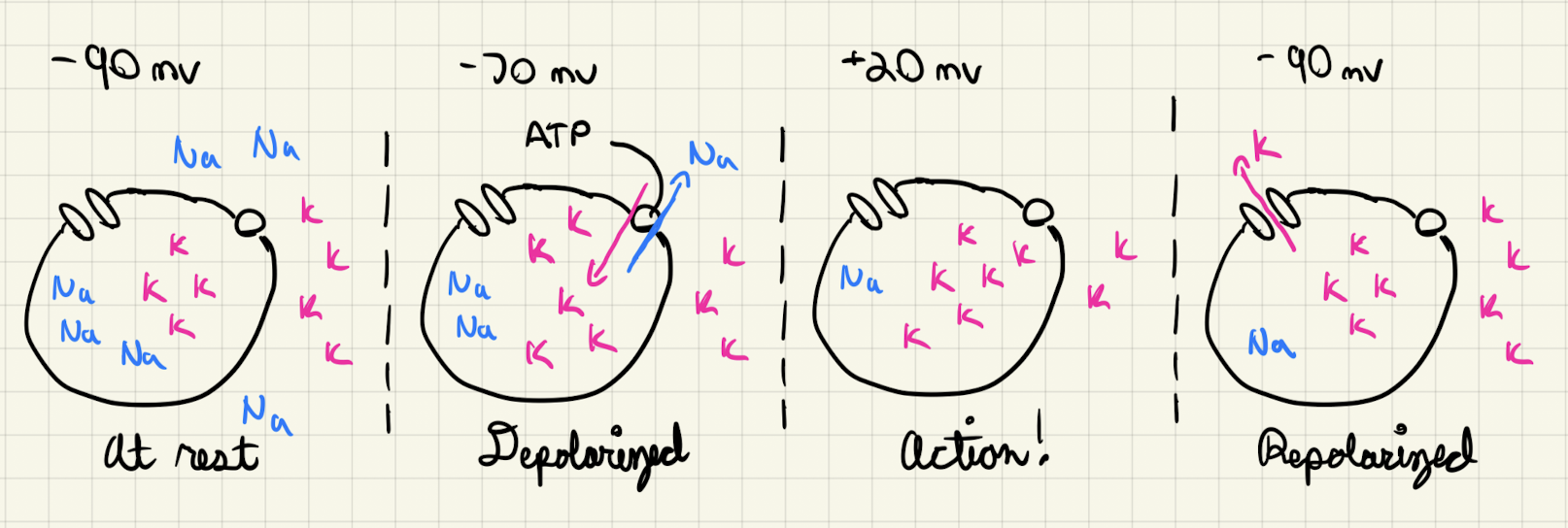
Hyperkalemia
- Too much serum K\(^+\).
- K\(^+\) does not osmose out of the cell.
- Cell cannot repolarize after an action potential.
- Muscles become "floppy"— lose tone and cannot contract.
The primary symptom of hyperkalemia is muscle weakness.
Hypokalemia
- Not enough serum K\(^+\).
- No K\(^+\) to pump into cells.
- Cell cannot depolarize to start an action potential.
- Muscles become "floppy"— lose tone and cannot contract.
The primary symptom of hypokalemia is muscle weakness.